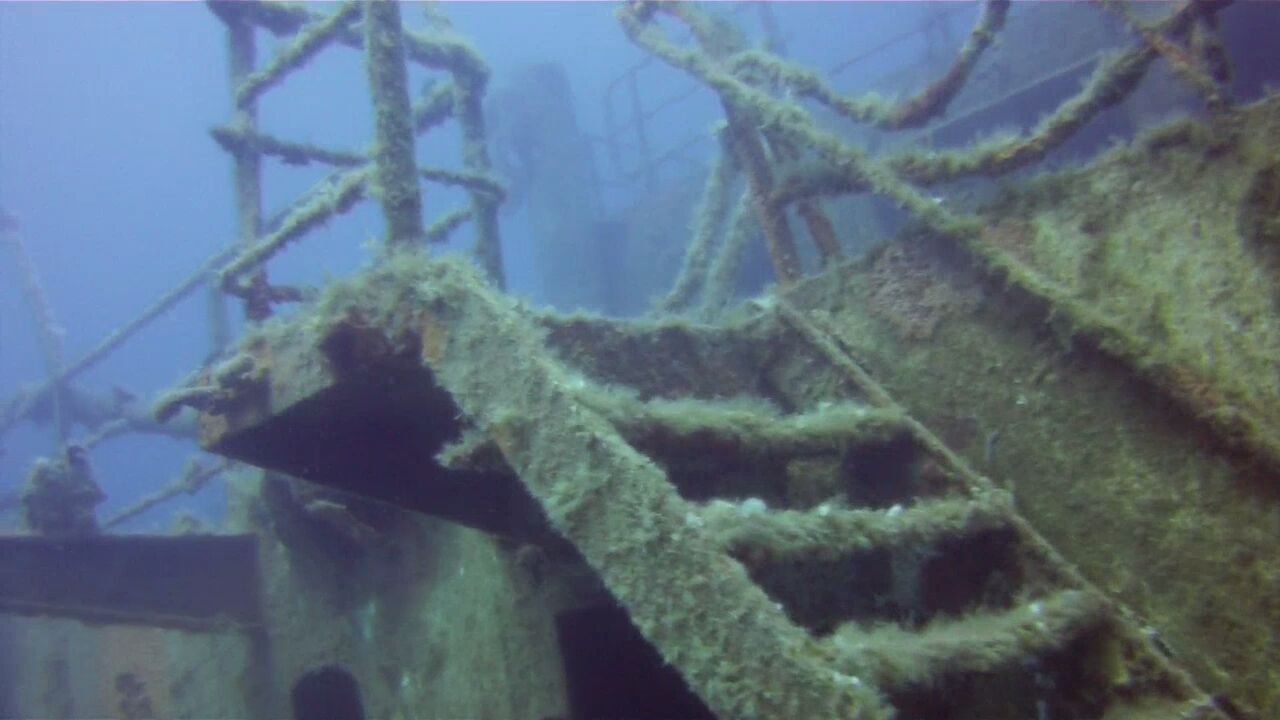
Wreck · 18–36m / 59-118ft
Um El Faroud
One of the dive sites we run here in Malta — here's the story behind it, the depth and access, and what it takes to dive it properly.
One of the dive sites we run here in Malta — here's the story behind it, the depth and access, and what it takes to dive it properly.
MV Um El Faroud was a steel motor tanker built by Smith's Dock Co. at Middlesbrough, England, and launched on 31 May 1969. She was about 110m long with a 15.5m beam. Launched as Seafalcon and working out of Norway for four years, she was renamed Um El Faroud in 1973 in Libya and ran refined fuel between Italy and Libya until 1995. On the night of 3 February 1995, while in dry dock in Grand Harbour for maintenance, an enormous gas explosion tore through the ship. Nine Maltese shipyard workers were killed — seven instantly and two later in hospital — one of the worst peacetime disasters in Malta's history. After three years laid up in Valletta, she was patched and towed to Wied iz- Zurrieq, where she was scuttled as an artificial reef and diving attraction on 2 September 1998, sinking a few hours after arrival. She sits upright on a sandy bottom from about 15m at the funnel to 36m at the propeller. During a heavy storm in the winter of 2005-2006 she broke in two amidships; the sections have shifted so that the bow and stern no longer align, leaving a gap of a few metres between them. A memorial to the nine workers stands above the site. Vast, atmospheric and richly colonised, she is one of Malta's signature dives and an outstanding platform for Advanced Nitrox and wreck training.
The Um El Faroud is a shore dive from Wied iż-Żurrieq — a small fishing village on Malta's south coast with a narrow inlet and steep steps down to the water. There's a dedicated dive site entry point; you kit up at the top and descend the steps to the water's edge. The wreck is about 100m out and immediately visible on the sand once you drop below 10m. She's enormous — 110m of steel tanker sitting upright, and even knowing the size from the specs you're still not quite prepared for the scale when you arrive.
The break amidships is one of the defining features of the dive. The 2005-2006 winter storms that split her left a gap of a few metres between the bow and stern sections, the two halves slightly misaligned. You can hover in that gap and look the length of both sections simultaneously — one of the more striking compositions in Mediterranean wreck diving. The funnel sits at around 15m and is usually first landfall; from there you descend the hull to the propeller at 36m, which is large and still largely intact.
Penetration is extensive and the wreck is well-known for it. The holds and cargo spaces run the full length of the vessel and allow genuine exploration for trained wreck divers. The engine room is accessible mid-ship. Ambient light inside is reasonable in summer at midday, but you want a torch — the interior spaces are large and atmospheric rather than tight, nothing like the confined sections you find in smaller wrecks, but dark enough to lose detail quickly without a light.
The marine life is outstanding. Nudibranch colonies cover much of the outer hull; fireworm, moray eels and scorpionfish are constant companions. Large grouper hold station off the bow. In summer the wreck is encrusted with colour — hard and soft corals establishing steadily in the 27 years since scuttling. The memorial plaque for the nine workers who died in the 1995 explosion is on the hull; worth finding and worth a moment.
Conditions are generally benign — Wied iż-Żurrieq faces south and is sheltered from the dominant north-west weather. In a south or south-east swell the entry steps get surgy and we wait it out. Visibility is routinely 20–25m and often better. This is a genuinely excellent dive at any certification level — there's enough at 15–20m to keep a recreational diver happy for 60 minutes, and enough at 36m to reward a properly planned technical decompression dive.
The diving here suits divers at Decompression Procedures level. If you’re not there yet, these are the courses that get you there:
Already certified and just want to dive it? Come and explore it with me on open circuit or CCR — one relaxed dive a day, no rushing, as long in the water as you like.
Want to dive Um El Faroud? Tell me your certification level and your dates, and I'll plan it with you. No pressure, no hard sell — just a good dive.