What This Course Is
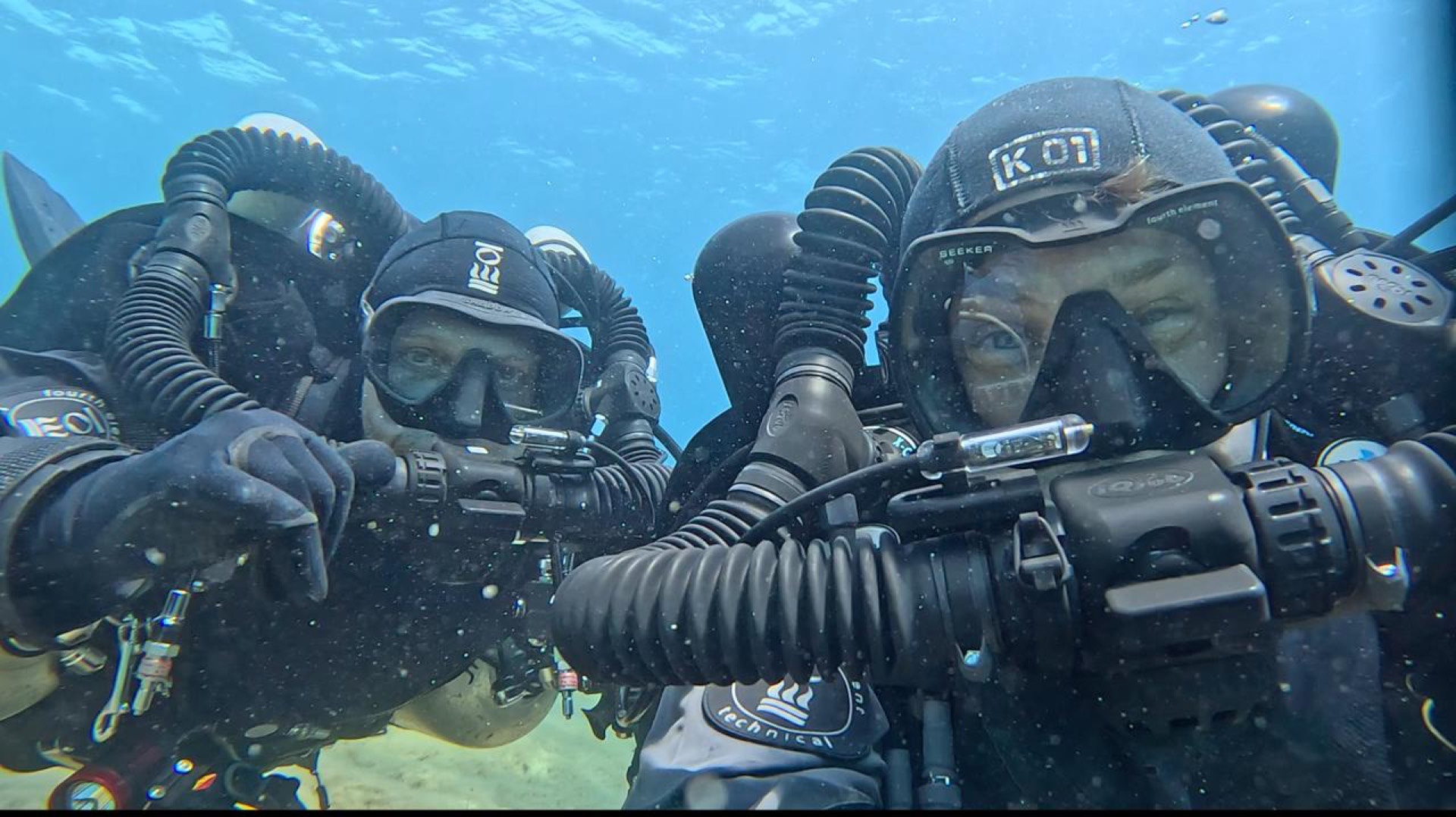
CCR diving is transformative — the extended bottom times, the silence, carrying a fraction of the gas you'd need on open circuit, and the way marine life behaves when there are no bubbles fundamentally changes how you experience underwater environments. It's also technically demanding equipment that requires thorough training and disciplined execution. This course gives you both.
The CCR Air Diluent course is your entry point into closed-circuit rebreather diving. Training is unit-specific — you learn on the actual rebreather model you'll be diving, not a generic CCR concept. Every unit has different electronics, different scrubber configuration, different bailout procedures and different failure modes. Theoretical knowledge and hands-on unit familiarity are both essential.
We dive to 30 metres maximum on air diluent. That ceiling exists because air diluent CCR has oxygen partial pressure implications that limit safe depth, and because 30m on a rebreather with a solidly understood unit is actually a genuinely excellent diving experience. Malta's shallower wrecks — the P29 tops out at 12 metres, the Rozi sits at 34m — are perfectly suited to this level of training. You'll also understand why the depth limit exists rather than just accepting it as a rule.
The course runs 5–7 days and that's not generous — it's what's required to do it properly. Pre-dive checks alone take time to internalise properly. The correct response to a high-oxygen warning takes trained muscle memory, not a think-about-it moment at 25 metres. We build those responses through repetition, in the water, until they're automatic. None of that tick-box nonsense where you read a checklist once and move on.
If you come in not knowing which unit you want to train on, we'll talk through the options. If you already own a unit, we can work with that.
What You'll Cover
- CCR physiology and theory — oxygen partial pressure management, hypoxia and hyperoxia, CO2 scrubber function and failure, loop gas management
- Unit assembly and pre-dive checks — pre-dive, pre-water and pre-dive procedures for your specific unit. These are non-negotiable and you'll do them until they're automatic
- Bailout procedures — when and how to exit the loop, bailout gas management, buddy bailout protocols
- Monitoring and setpoint management — reading and interpreting your handsets, manual versus automatic setpoint control
- In-water procedures — buoyancy on a CCR (different from OC), ascents and descents, gas additions, staying in the loop
- Emergency procedures — responding to oxygen warnings, scrubber breakthrough recognition, flooded loop management, catastrophic failures
- Post-dive maintenance — scrubber packing, unit cleaning, storage, record keeping
What You Need Beforehand
- Nitrox certification (Advanced Open Water also recommended)
- Minimum 25 logged dives
- Age 18+
- Medical fitness — CCR diving has specific medical considerations. A current medical from a diving physician is required
This is unit-specific training. Contact me to discuss which CCR unit is appropriate for your diving goals and budget before booking. Getting the right unit for where you want to go is a conversation worth having early.
What It Opens Up
CCR Air Diluent is the foundation for all further rebreather training — CCR Decompression Procedures and CCR Mixed Gas / Helitrox both build directly from here. It also opens up a style of diving that experienced open-circuit divers consistently describe as a revelation. The silence alone is worth it — Malta's wrecks become a completely different experience with no bubbles, and the marine life behaves differently when you're not exhaling.