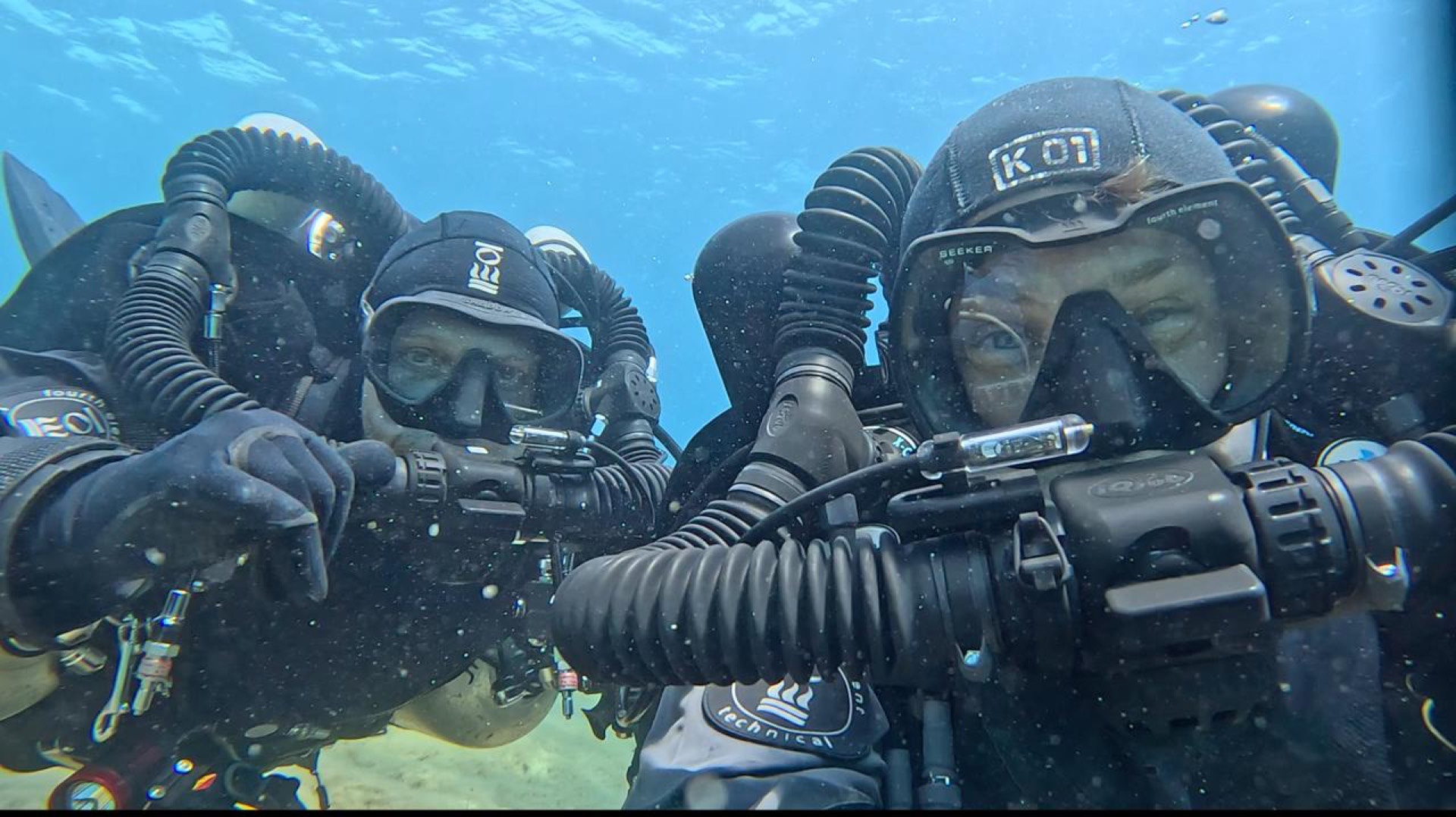
What This Course Is
One of the things that often surprises open-circuit divers converting to CCR is that rebreather decompression works differently from what they're used to — and in many ways better, if you understand how to manage it. On CCR, you have continuous control over your oxygen partial pressure throughout the ascent. You can hold a high setpoint during your deco stops, accelerating inert gas off-gassing. You can optimise your decompression in real time based on what the unit is doing. It's genuinely powerful — and genuinely requires proper training to do safely.
The TDI CCR Decompression Procedures course covers planned staged decompression on a closed-circuit rebreather to 45 metres. We're specifically looking at how the rebreather changes the decompression picture compared to open circuit: setpoint selection during ascent, optimising stops with elevated PO2, managing the deco schedule when the unit behaves unexpectedly, and how bailout procedures interact with a decompression obligation.
Bailout planning is given particular focus throughout this course. A bailout from a CCR dive with a significant decompression obligation is a complex situation requiring pre-planned procedures and sufficient gas. At 45m with meaningful bottom time, those requirements are substantial — and the consequences of inadequate bailout planning during a decompression emergency on a rebreather are severe. We work through this in detail.
Malta's wrecks at the 30–45m range are excellent training grounds for this course. The MV Karwela at 45m gives you a proper decompression dive on a genuinely interesting wreck. Le Polynesien deeper down shows you what you're training toward. The visibility means you can actually see your handsets, your stops, and your team — which makes the learning process significantly better than murky northern European water.
3–4 days is the minimum for this course and it doesn't feel like padding. Decompression planning at this level, combined with CCR-specific considerations, takes time to develop properly. We'll work through it until it genuinely clicks — that's what the time is for.
What You'll Cover
- CCR decompression theory — how constant PO2 changes the decompression model compared to open circuit, inert gas tracking on the unit
- Setpoint strategy for decompression — optimal setpoints for each phase of a deco dive, including elevated setpoints during stops
- Dive planning for CCR deco dives — planning software in the CCR context, bailout gas calculations, contingency planning
- Bailout during decompression — managing an open-circuit bailout while completing a decompression obligation, sufficient bailout gas requirements
- Executing the deco schedule on the unit — running stops on the rebreather, managing setpoint during stops, dealing with unit problems during decompression
- Team procedures for CCR deco dives — signalling, stop management as a team, team bailout procedures
What You Need Beforehand
- TDI CCR Air Diluent certification on the same unit
- Minimum 50 logged dives, with solid CCR experience
- Age 18+
- Current diving medical
This course can be run in combination with CCR Mixed Gas / Helitrox for divers who want to approach decompression diving at greater depth from the start. Talk to me about sequencing if that's your direction.
What It Opens Up
CCR Decompression Procedures is the foundation for all serious CCR diving. Once you can plan and execute staged decompression on the unit, you've got the skills that everything deeper builds on — and combined with helium diluent (from the Mixed Gas course) it opens Malta's deeper wrecks down into the 60m range. Malta's very deepest sites, like HMS Olympus at 115–130m, lie beyond standard CCR Mixed Gas and into advanced exploration territory.