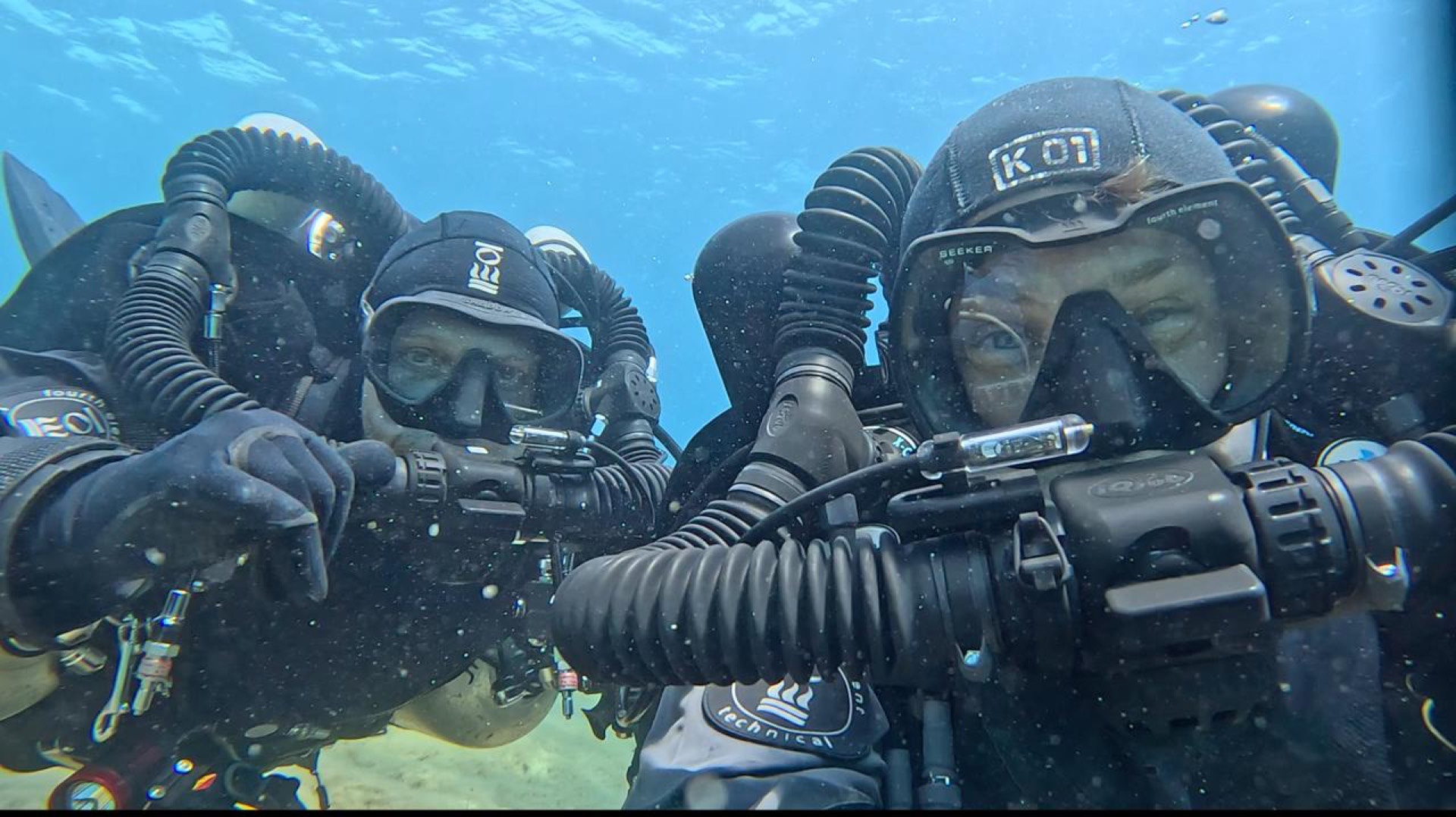
What This Course Is
TDI CCR Mixed Gas takes qualified rebreather divers deeper with helitrox — a helium-oxygen diluent mix that extends CCR diving to 60 metres with managed narcosis and bottom times that far exceed what's possible on open-circuit trimix. If you're a confident CCR diver ready to access deeper wrecks, this course opens that door.
Adding helium to the loop changes things. The gas density decreases, which is a genuine advantage at depth. The narcosis fraction drops significantly — which is precisely the objective at these depths. But it also introduces isobaric counterdiffusion considerations that are more complex in a CCR context than in open circuit, and the setpoint management across a deep dive with a helium diluent requires careful thought and disciplined execution. This is not a course where you just swap out the diluent cylinder and dive the same way.
HMS Stubborn sits at 57 metres. On CCR with helitrox diluent, you can spend genuine time on her — not the compressed bottom time that open-circuit divers are managing, but proper exploration time with a fraction of the decompression obligation. Le Polynesien, whose main structure sits within the 60m limit of this qualification, becomes a proper exploration dive. These are transformative dives, and they're exactly what this course is building toward.
Over 5–7 days the course covers the theory — helium in the loop, diluent selection, setpoint strategy at depth — before moving into progressive in-water application. Training starts at moderate depth to confirm unit handling with the new diluent, building systematically to the target depth on genuinely interesting sites. The progression is deliberate — reaching 60m on a rebreather is only meaningful when the execution is solid.
Malta is an excellent location for this course. Warm water allows real bottom time, exceptional visibility makes it possible to clearly observe handsets, stops and team positioning, and the deep wrecks in this depth range are world-class. The sites require boat access and proper logistics — which is exactly what technical diving at this level demands.
What You'll Cover
- Helitrox diluent selection — choosing helium fraction for END management at target depth
- Isobaric counterdiffusion on CCR — why it's more complex in the loop context, how to avoid triggering it
- Setpoint strategy at depth — optimal setpoints for descent, bottom and ascent phases with helium diluent
- Bailout planning at depth — bailout gas requirements for deep helitrox dives, managing open-circuit bailout from 60m
- Extended decompression on CCR — using setpoint optimisation to accelerate decompression, managing long deco stops
- Deep CCR dive execution — gas addition procedures with helium diluent, ascent discipline, scrubber endurance at depth
What You Need Beforehand
- TDI CCR Air Diluent certification on the same unit
- Minimum 50 logged dives, with significant CCR experience since your Air Diluent cert
- Age 18+
- Current medical from a diving physician
Your bailout gas requirements increase significantly at 60m compared to 30m air diluent diving. We discuss this in detail during planning — bailout cylinder configuration for deep CCR dives is an important logistics conversation to have before the course.
What It Opens Up
CCR Mixed Gas / Helitrox opens up the 40–60m depth range on rebreather — which in Malta means HMS Stubborn, Le Polynesien approaching the limit, and a completely different experience on the wrecks you've already dived shallower. The next step is CCR Decompression Procedures, which focuses specifically on managing extended deco obligations on the unit.