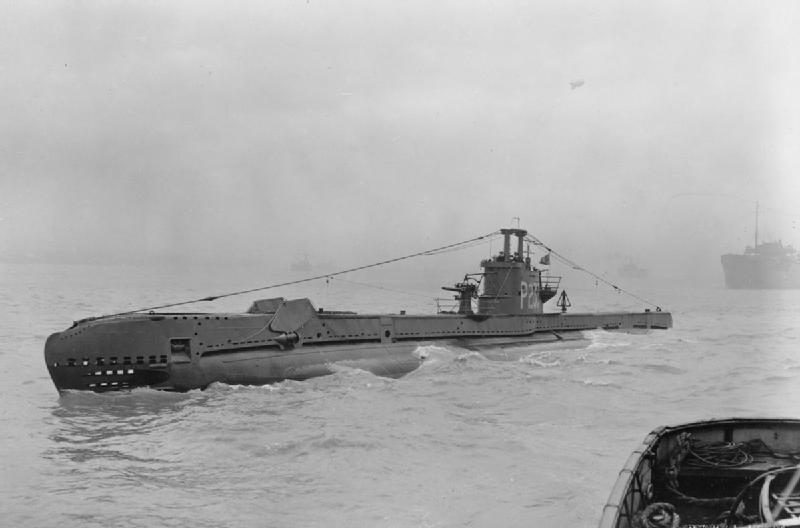
S-class submarine (Royal Navy) · P238 · 57m
HMS Stubborn
One of the dive sites we run here in Malta — here's the story behind it, the depth and access, and what it takes to dive it properly.
One of the dive sites we run here in Malta — here's the story behind it, the depth and access, and what it takes to dive it properly.
HMS Stubborn was an S-class submarine of the Royal Navy, launched by Cammell Laird on 11 November 1942. She had a busy, dramatic war — patrolling off Norway and in the Bay of Biscay, attacking German shipping and U-boats, before deploying to the Far East in 1945, where she accounted for three Japanese vessels.
Her most famous moment came on 11 February 1944. After attacking a German convoy off Norway she was caught by escorts and savagely depth-charged. The blasts jammed her aft hydroplanes hard a-dive, flooded an internal tank and damaged a propeller — and Stubborn plunged out of control to around 500 feet, some 200 feet beyond her designed maximum depth. That she held together and fought her way back to the surface is one of the great submarine survival stories of the war.
Stubborn came through the conflict, but like many submarines she was expended afterwards. On 30 April 1946 she was deliberately sunk off Malta as an ASDIC target, helping train the sonar operators of the post-war Royal Navy.
Today she lies upright, with a slight list to starboard, on a sandy seabed at around 57 metres roughly 3km north-east of St Paul's Bay. Largely intact and unmistakably a submarine, she's one of Malta's most rewarding technical wrecks — within reach of Trimix divers, and a firm favourite for very good reason.
Stubborn requires a boat dive, roughly 3km north-east of St Paul's Bay. She lies upright with a slight starboard list at 57m, largely intact apart from flood damage to the pressure hull. The conning tower is the first landmark — rising to about 45m, unmistakably submarine in shape. From there you can work forward to the bow or aft past the damaged section to the stern, where the propellers are visible and the deck plates have opened slightly on impact.
Bottom time at 57m on open circuit is short — on Trimix you're working with 15–20 minutes of bottom time before a substantial decompression ceiling. The standard approach is a targeted exploration of one section per dive: conning tower and bridge first dive, bow second dive, stern and aft section third. Rushing a wreck at this depth produces nothing good. On CCR the equation changes considerably — considerably longer deco for the same decompression obligation means much more time on the wreck per dive.
The marine life density is striking. Lobsters occupy almost every crack in the hull; large grouper circle the conning tower. The sand around the wreck is clean Mediterranean blue, and on a clear day the ambient light at 57m is better than you might expect — colours are muted but the visibility can reach 25–30m. This is an advanced technical dive requiring proper Trimix qualification, a solid dive plan, and the self-discipline to stick to it.
The diving here suits divers at Trimix Diver level. If you’re not there yet, these are the courses that get you there:
Advanced Wreck belongs on this list too. It isn’t what raises your depth limit — your gas qualification does that — but it’s what makes penetrating a wreck at this depth a sensible thing to do: long line work, losing the line and finding it again, and out-of-gas contingencies inside an overhead.
Already certified and just want to dive it? Come and explore it with me on open circuit or CCR — one relaxed dive a day, no rushing, as long in the water as you like.
Want to dive HMS Stubborn? Tell me your certification level and your dates, and I'll plan it with you. No pressure, no hard sell — just a good dive.