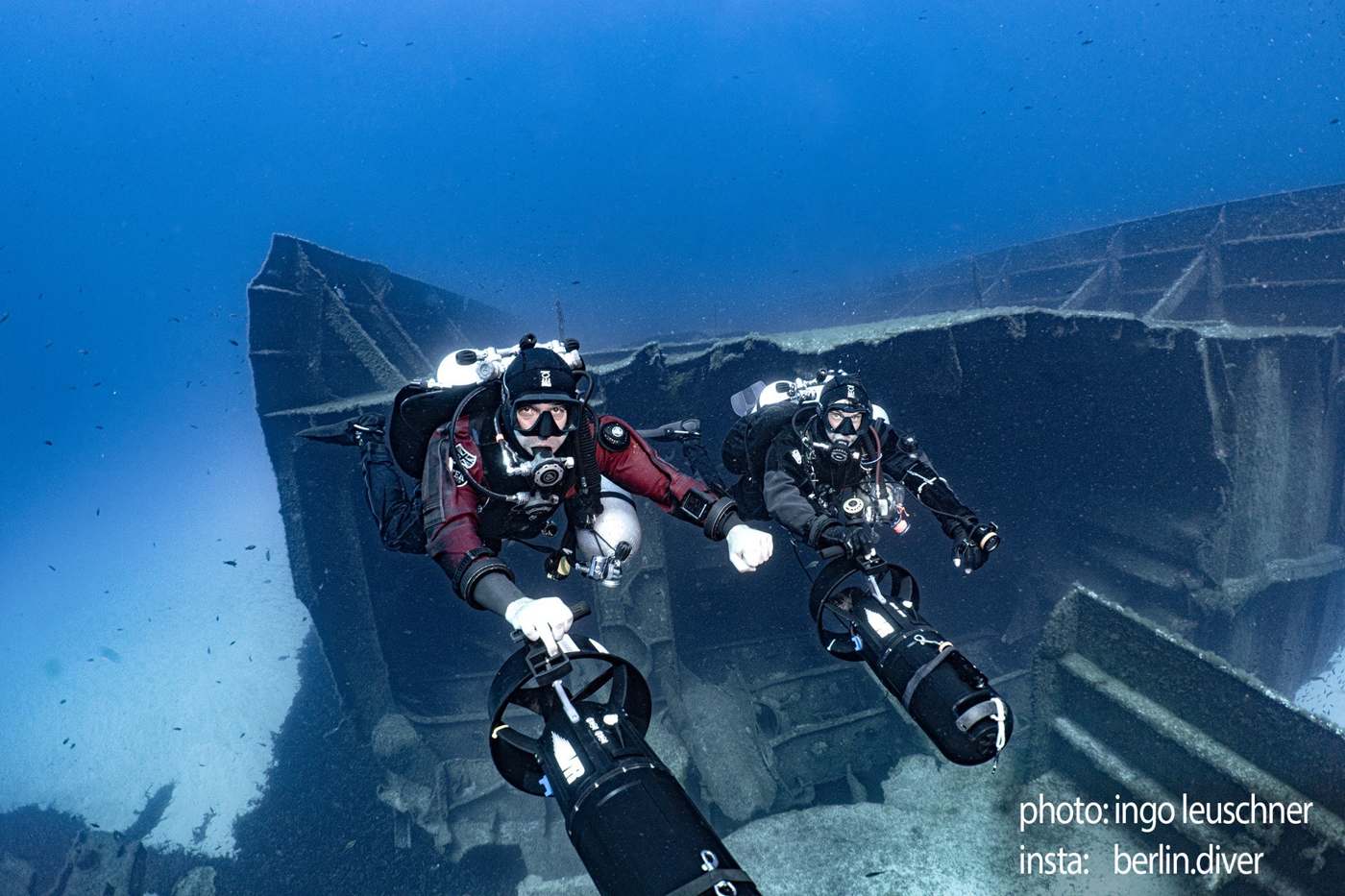
What This Course Is
A Diver Propulsion Vehicle (DPV) transforms your dive capability — covering distances that would consume your gas supply on fins while arriving with bottom time to spare. The concept is straightforward, but the practice requires specific training: DPVs change your gas consumption calculations, extend your range significantly, and introduce equipment failure scenarios that need proper management.
The TDI Technical DPV Diver course teaches you to use a scooter properly — not just how to point and go, but how to plan a DPV dive, manage the vehicle during a dive, handle failures underwater, and think about the extended range implications for your gas supply. DPV dives are inherently longer-range dives, which means if something goes wrong at the far end, you have further to get back. That changes everything from turn points to emergency procedures.
Malta is excellent for DPV diving. The run from the Inland Sea entrance through to the Blue Hole at Dwejra is a classic — you cover distance that would eat your bottom time on fins, and you arrive with gas to spare. The P29 and Rozi site off Cirkewwa is another good one: two wrecks separated by enough distance that a DPV dive covering both properly is a much better experience than a split-focus fin dive.
It's a one-day course: the technical side in the classroom, vehicle handling skills in controlled conditions, then proper DPV dives on actual sites. By the end you'll be confident managing the vehicle, executing a DPV dive plan, and handling the scenarios that arise — including equipment failures, which are part of the training and part of the reality of diving with powered equipment. Because it runs in a day, you can slot it in at the start of a trip and have it pay off on every dive after.
If you're interested in using a DPV for technical diving at depth — which is where scooters really come into their own for covering distance while managing decompression — that's a different and more complex conversation that bridges into the technical curriculum. Mention it and we'll talk about it.
What You'll Cover
- DPV mechanics and maintenance — how the vehicle works, basic maintenance, pre-dive checks, recognising problems before they become emergencies
- Buoyancy and trim with a DPV — how the vehicle changes your neutral buoyancy, maintaining trim while being pulled through the water
- Gas planning for DPV dives — extended range changes the rule of thirds calculation, turn pressure planning with vehicle-assisted travel
- Failure procedures — vehicle failure underwater, towing a failed DPV, abandoning a vehicle safely, out-of-gas scenarios at extended range
- Team diving with DPVs — maintaining buddy contact at speed, communication, what happens when one DPV fails in a team
- Site and route planning — planning a DPV route, exit point considerations, surface marker deployment at range
What You Need Beforehand
- Advanced Open Water or equivalent
- Minimum 25 logged dives
- Age 18+
- Good buoyancy — a DPV amplifies any buoyancy issues, so you need to be reasonably solid before we start
“Had a brilliant time technical diving with a DPV… felt spoilt to be individually looked after. One of my best experiences, and I will be coming back for more soon.”
Rob Hughes, TDI DPV Diver · More testimonials
DPVs are available for hire as part of this course programme. You don't need to own one. If you do own a specific model and want training on that vehicle, let me know when you enquire.
What It Opens Up
DPV certification means longer, more productive dives on Malta's extended sites — connecting dive sites that would otherwise require separate dives, covering more of large wreck sites, and accessing areas at range that are impractical on fins alone. It's a genuinely useful addition to any diver's toolkit, especially in a destination with as much underwater geography as Malta.